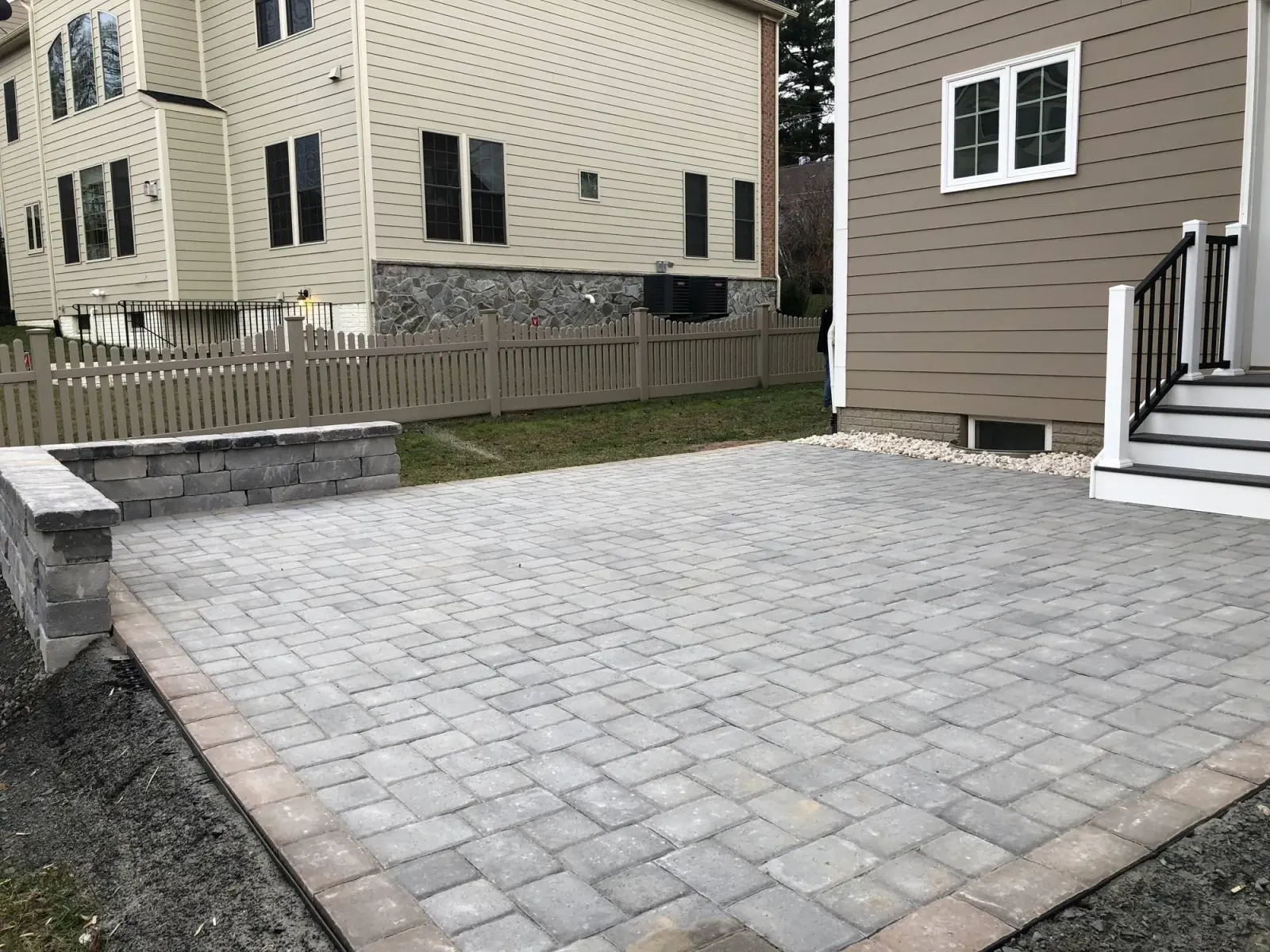
We built our first patio in 1991. Over three decades later, a steady part of our work is still tearing out patios that someone else built. Heaved steps. Sunken corners. Joints full of weeds by year three. Almost every failure we dig up traces back to a decision made before a single stone arrived: who got hired. Here is how we would pick a builder if we were the ones writing the check.
The short answer
Verify the Virginia license and insurance yourself, not on the contractor’s word. Ask more questions about the base than about the surface. Insist on local photos and real addresses. Read the middle reviews, not just the five-star ones. Get every detail of the scope in writing before you sign. And walk away from anyone who pressures you to commit on the spot. The rest of this post covers how to actually do each of those.
Verify the Virginia license and insurance
Virginia licenses contractors through the Department of Professional and Occupational Regulation, DPOR for short. Licenses come in Class A, B, and C, and the class caps how large a project the company can legally take on. Most full patio builds fall in Class A or Class B territory.
Do not take the license on faith. Ask for the number, then run it through DPOR’s public license lookup. It takes two minutes and shows whether the license is active, what class it is, and whether the state has disciplined the company. We have met homeowners who found out after a failed project that the “licensed” builder was borrowing someone else’s number.
Insurance is the other half. Ask for a certificate of general liability insurance and workers compensation, and ask that the insurer send it to you directly. A legitimate company does this all the time and will not blink. If a machine clips your neighbor’s fence or a laborer gets hurt in your yard, that certificate is what keeps the contractor’s problem from becoming your problem.
Ask about the base, not just the pavers
The surface sells the patio. The base decides whether it is still flat in ten years. Northern Virginia sits on heavy clay that holds water, and our winters freeze and thaw that water over and over. A patio built on a thin or sloppily compacted base will move. Not might. Will.
So ask specific questions. How deep do you excavate? What base material do you use, and how thick is it after compaction? Do you compact in lifts or dump it all in at once? Do you lay geotextile fabric over clay soils? How do you set the finished grade so water runs away from the house instead of toward it? A serious builder will answer in detail and probably enjoy the conversation. A crew that shrugs and says “we do it the standard way” has told you everything you need to know. If you want to hear what good answers sound like, we walk through our own paver patio construction process step by step.
Natural stone raises the bar further. Flagstone should never be flopped onto dirt and sand and called finished. We set flagstone in a full mortar bed over a reinforced concrete slab, so the surface is bonded to a foundation that does not shift with the seasons. If a bidder proposes flagstone with nothing under it, keep interviewing.
Look for local photos of finished work
Any company can fill a website with borrowed images. Ask to see projects they personally built in this area, and ask for a couple of addresses of patios that are at least three or four winters old. Then drive by. Every patio looks great the week it is finished. The truthful photo is the one taken years later. Are the steps still tight? Are the edges straight? Have the joints washed out?
Local experience matters more than people expect. A builder who has worked this region’s clay for decades has already made the mistakes a newcomer is about to make in your backyard. Our own gallery of finished patios, walkways, and stone steps is there for exactly this reason: real yards, real projects, nothing borrowed.
Read reviews the right way
Star averages tell you very little. Here is how we read reviews when we hire trades ourselves. Start with the three-star reviews, because that is where honest, mixed experiences live. Then look at how the company responds to criticism. A calm, specific reply says more about who will show up at your house than a hundred five-star ratings.
Look for reviews that mention communication, schedule, and cleanup, since those are the things that actually go wrong. Look for older reviews that mention how the work held up. And be suspicious of a pile of glowing reviews posted in the same month. Reputations are built over years, not weekends.
Get the full scope in writing
Every quote you compare should itemize the same things: excavation depth, base material and compacted thickness, bedding layer, the exact paver or stone and the pattern, edge restraint, joint material, final grading, lawn protection, haul-away of spoils, a start window, an estimated duration, a payment schedule tied to milestones, and who calls Miss Utility before digging.
This is not paperwork for its own sake. Identical written scope is the only way to compare two or three bids honestly. When one number comes in far below the others, the written scope shows you what was quietly left out. In our experience, what gets left out is almost always underground, because that is the part you will never see.
Red flags we see homeowners regret ignoring
After 35 years of walking into backyards to fix other people’s work, these are the warning signs that come up again and again:
- A demand for a large deposit before any material has been ordered.
- No physical business address, just a cell phone and a magnetic truck sign.
- A bid dramatically lower than the others with no explanation of what was cut. It is usually the base.
- A one-page proposal with no excavation depth, no base thickness, and no compaction mentioned anywhere.
- “We can start tomorrow” in the middle of the busy season. Good crews are booked.
- Pressure to sign today because the offer expires tonight.
- Vague answers about who will actually be on site doing the work.
- Reluctance to give addresses of past projects.
None of these alone proves a builder is bad. Two or three together is a pattern, and patterns in this business rarely improve after the contract is signed.
Questions to bring to your estimate visit
Print this list and use it on every company you meet. The comparison between their answers is worth more than any single answer.
- Who will be on site, your own crew or a subcontractor, and who supervises them?
- How deep do you excavate, and what goes back into the hole?
- How do you compact the base, and in how many lifts?
- How will you grade the patio so water moves away from the house?
- What edge restraint do you use, and how is it anchored?
- Who calls 811 to have utilities marked before digging?
- If you hit something unexpected underground, how are changes handled and documented?
- Can you give me two addresses of projects at least three years old?
- Who is my single point of contact from contract to final walkthrough?
- Realistically, when can you start, and how long will my project take?
A builder worth hiring will not be annoyed by this list. We would rather spend an extra half hour answering questions than spend a spring tearing out someone’s disappointment.
We are based in Herndon and have been building here since 1991, and we are glad to be one of the two or three companies you compare. If you want a patio contractor in Northern Virginia who will answer every question on this list without flinching, call us at (571) 620-6218 and put us to the test.