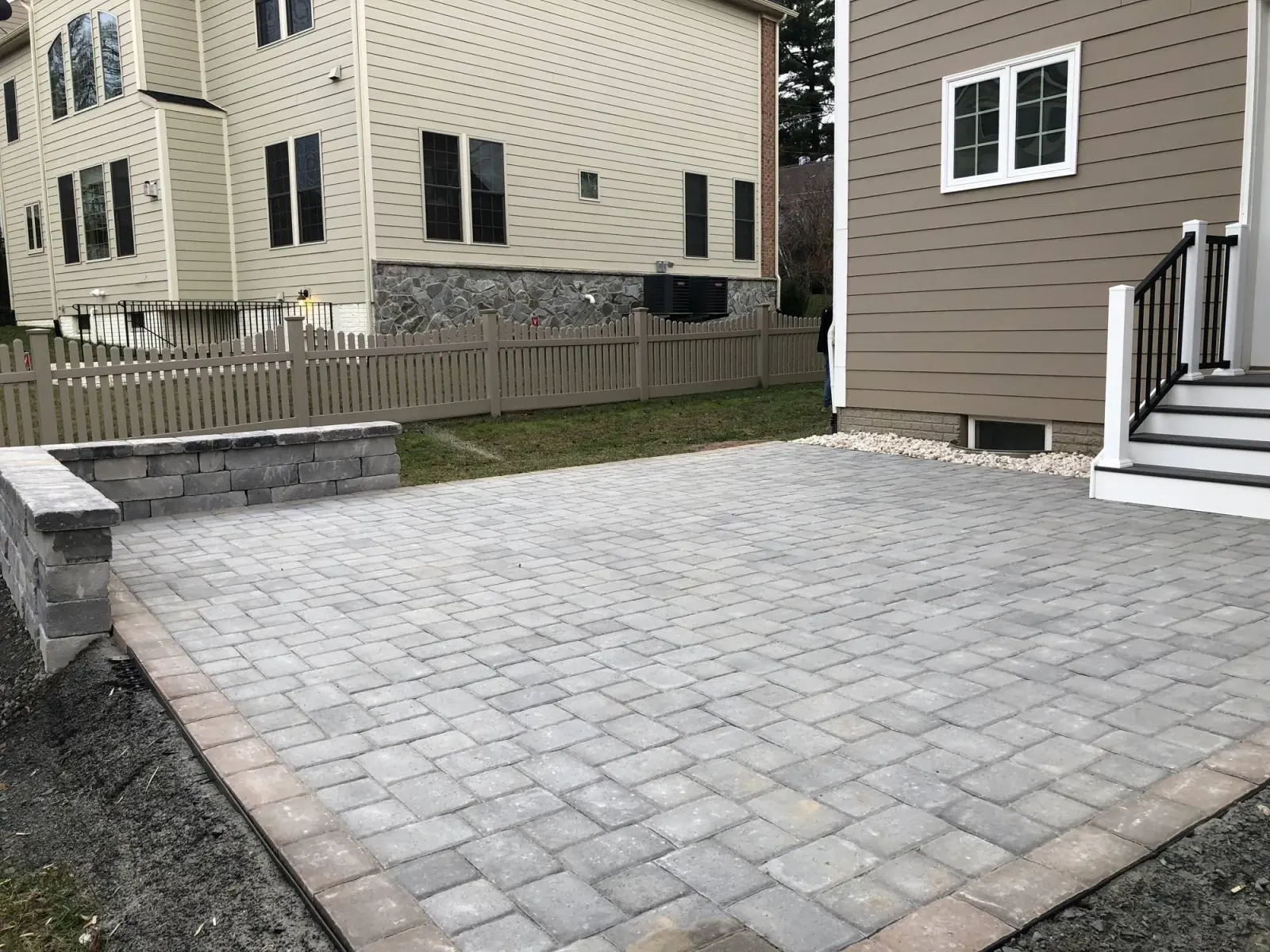
We have been building patios in Northern Virginia since 1991, and this is still the question we hear most on a first visit: should we do pavers or just pour concrete? Both are legitimate patios. But after 35 years of standing in these backyards, digging into this clay, and getting called out to look at surfaces other people built, we have a clear answer and honest reasons behind it.
The short answer
For most backyards here, pavers win. They handle our freeze-thaw winters better, they can be repaired invisibly, and they give you far more design room. Poured concrete is a fine surface for a garage floor or a shed pad, where flatness matters more than looks and a crack is a cosmetic issue. As an outdoor living surface in this climate, it asks you to accept things pavers do not. Stamped concrete sits in the middle, and we will give it a fair hearing below.
How freeze-thaw treats each surface
Northern Virginia winters are not brutal, but they are busy. We rarely get one long deep freeze. We get dozens of cycles where the ground freezes at night and thaws by afternoon, week after week, from December into March. Water in the soil expands when it freezes, and every one of those cycles pushes on whatever is sitting above it. Add the heavy clay under much of Fairfax and Loudoun, which holds water instead of shedding it, and you have soil that moves.
A poured slab is one rigid piece. It cannot flex, so when the ground under one corner heaves and the other corner stays put, something has to give. The slab gives. That is why contractors saw control joints into concrete: not to prevent cracks, but to try to tell the cracks where to go. The cracks do not always listen.
A paver patio is hundreds of separate units on a deep bed of compacted aggregate. When the ground moves, each paver can shift a hair and settle back. The sand joints absorb the movement instead of transmitting it. The open aggregate base also drains, so there is less saturated soil directly under the surface to freeze in the first place. The patio flexes as a system. Nothing rigid, nothing to snap.
Cracking, staining, and repairs
Here is where the two materials really separate, because every patio eventually needs something.
When concrete cracks, your repair options are ugly. You can caulk the crack and look at a gray line forever. Or you can saw-cut a section, break it out, and pour a patch, and that patch will never match the surrounding concrete. New concrete cures to a different shade than twenty-year-old concrete, full stop. We have seen a lot of patched slabs. We have never seen one you could not spot from across the yard.
Concrete also stains. It is porous, so rust from furniture feet, oil, and leaf tannins soak in. Pressure washing helps, but a slab rarely looks clean the way it did the first summer.
Pavers repair the opposite way. If a section settles, say near a downspout that dumped water into the base for a few years, we lift those pavers, rebuild and recompact that spot, and relay the same pavers. Done well, you cannot tell it happened. A stained or chipped paver comes out and a spare goes in. We tell clients to keep a small stack of leftovers from their job for exactly this reason. Ever need to run a gas or electric line under the patio? The pavers come up and go back down. Try that with a slab.
Appearance and design flexibility
A broom-finished gray slab is a broom-finished gray slab. It reads as utility, not as a finished outdoor space.
Pavers give you real design vocabulary: sizes, textures, color blends, running bond or random-ashlar patterns, contrasting border courses, and clean curves. Curves matter more than people expect. Forming a poured slab into a sweeping radius is fussy work, so most concrete patios end up rectangles. With pavers we cut the curve we want, and the patio can follow the shape of the yard instead of fighting it. You can see how we detail borders, steps, and curves on our paver patio page, and the finished results in real Northern Virginia backyards.
If you are drawn to natural stone rather than a manufactured unit, that is a different comparison, and we have compared pavers with natural flagstone separately. Short version: we set flagstone in a full mortar bed over a reinforced concrete slab, which is a masonry surface with its own character and its own build method.
Stamped concrete: the honest middle case
Stamped concrete deserves a straight answer, because a freshly stamped and sealed patio genuinely looks good. The color is rich, the texture mimics stone, and there are no joints to sand.
But it is still a monolithic slab. Everything we said about freeze-thaw and cracking applies in full, and the stamping actually raises the stakes. A crack through plain gray concrete is a flaw. A crack wandering through a fake-stone pattern breaks the illusion the whole surface depends on, and a patch is even more visible because now it has to match color and pattern. The color itself lives mostly at the surface, so it needs resealing every few years or it fades and dulls, and fresh sealer can leave the surface slick when wet.
Some stamped patios in this area hold up fine for a long while. If you get one, you are betting on the slab not cracking, and in this soil that is a bet, not a guarantee. We do not pour stamped concrete, and that is why.
Long-term value in a NoVA backyard
Forget day one. Compare the two patios at year ten.
The ten-year-old slab has cracks, some settling toward the house or away from it, and a surface that shows its age. Your realistic options are to live with it, patch it visibly, or demolish it and haul it away.
The ten-year-old paver patio, built on a proper base, mostly just needs its joint sand topped up and maybe an afternoon of releveling at one edge. It is fully serviceable, and it still looks like a finished space when you walk a buyer through the backyard. That serviceability is the real value story: a surface you can maintain and repair for decades versus a surface you eventually replace.
What we build and why
We are a Herndon-based crew and we have built hardscapes across Northern Virginia since 1991. We build paver patios on deep compacted bases, and natural stone set in full mortar beds over reinforced concrete slabs. We do not pour plain or stamped concrete patios, because we would rather build the surface we can stand behind in this climate than the one that is fastest to place.
If you are weighing pavers against concrete for your own backyard in Fairfax, Arlington, Loudoun, or Prince William, we are happy to walk the yard with you and talk it through honestly. Call us at (571) 620-6218 or request a free estimate, and bring your questions. After 35 years, we have probably stood on the answer.

