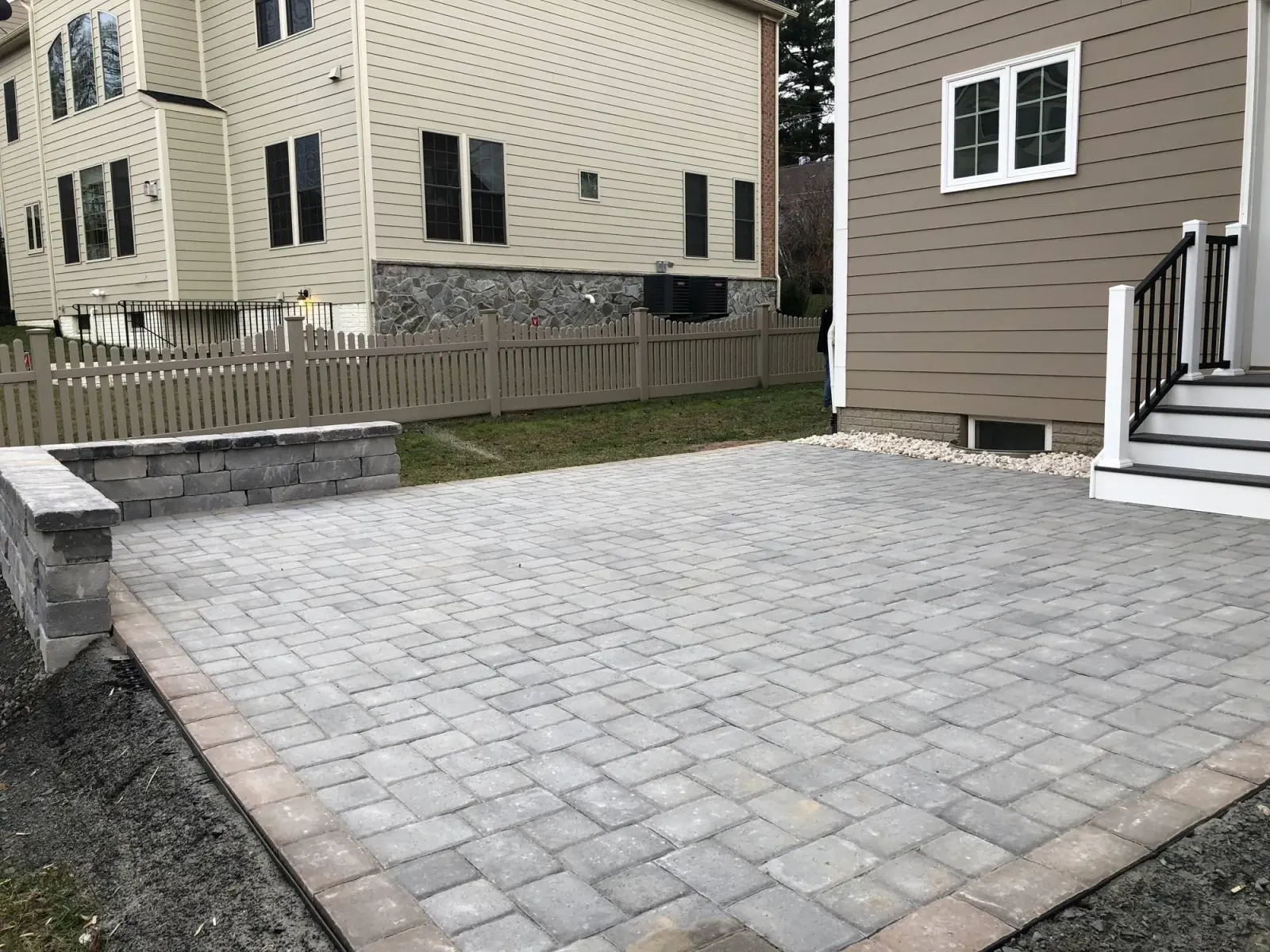
Every spring the phone rings with the same story. A patio that looked perfect in October is wavy by March. Pavers have dropped along the house, a corner has lifted, joints have opened up. The homeowner assumes the pavers failed. In 35 years of building patios in Northern Virginia, I can count on one hand the times the pavers were actually the problem.
The short answer
Patios fail from the bottom up. When pavers sink, heave, or spread, the cause is almost always under the surface: soil that was never compacted, a base that was too thin, or water trapped where it could freeze. Get the base right and a paver patio here will stay flat for decades. Get it wrong and no surface material will save the job. The patios we built in the early nineties that are still dead flat today all have one thing in common, and it is not the stone on top.
What freeze-thaw actually does to a patio
Water expands about nine percent when it freezes. Northern Virginia rarely freezes solid for months the way Minnesota does. Instead, we cross the freezing line over and over, sometimes forty or fifty times in a single winter. Warm afternoon, hard freeze overnight, thaw again by lunch.
Every one of those cycles, any water sitting in or under your patio base freezes, expands, and pushes upward. Then it thaws and everything settles back down, but never quite to the same spot. One cycle moves a paver a hair. Fifty cycles a winter, over three or four winters, and you have a surface that rolls like a gravel road. That is heaving. Sinking is the same water problem in reverse: water moving through a loose base carries fine material away with it, and the pavers follow the voids down.
Northern Virginia’s clay soil problem
Dig almost anywhere in Fairfax, Loudoun, Prince William, or Arlington and you hit clay within a foot. Some neighborhoods, especially in parts of southern Fairfax County, sit on marine clay, which is about the worst material you can build on. Clay holds water and releases it slowly. It swells when wet and shrinks when dry.
You cannot change the soil in your yard, and you should be suspicious of anyone who says they can. What a good builder does instead is separate the patio from the clay and keep water moving through and away from the base so it never sits there waiting for a freeze. Every layer of a proper base exists to do one of those two jobs.
Anatomy of a proper base
This is the same base system we put under every paver patio we build, and it has four parts.
Excavation. We dig out all the topsoil and anything organic, down to firm, undisturbed subsoil. Roots and dark, spongy soil will decompose and settle no matter how hard you compact them. How deep we go depends on the soil we find and what the surface will carry: a patio over soft clay needs more than one over decent soil, and a driveway needs roughly twice the stone a patio does. Then we compact the subgrade itself before a single stone goes in.
Geotextile fabric. Over clay, we roll out a woven geotextile separation fabric between the subsoil and the stone. Without it, years of wet-dry cycles slowly pump clay fines up into the aggregate, and stone contaminated with clay stops draining and stops holding compaction. Fabric is cheap, quick to place, and the step most often skipped, because nobody ever sees it.
Compacted aggregate in lifts. The structural base is dense-graded crushed stone, what Virginia suppliers call 21A or crusher run. The critical word is lifts. We place it two to three inches at a time and run a plate compactor over each lift before the next one goes down. Dump the full depth in one shot and compact the top, and you have compacted the top two inches and left everything below it loose. That loose stone consolidates over the next few years, and the patio follows it down. More failed patios trace back to this one shortcut than to everything else combined.
Bedding layer. On top of the compacted base goes about one inch of concrete sand, screeded flat. The bedding layer is for setting pavers, not for fixing a wavy base. Three inches of sand on a job means the crew was hiding sloppy base work, and that sand will rut and shift underfoot.
One note for natural stone: flagstone is a different system entirely. We set flagstone in a full mortar bed over a reinforced concrete slab, so the conversation there is about the slab and its footing rather than aggregate. But for interlocking pavers, the layers above are everything.
Pitch and grading so water leaves the patio
A flat-looking patio should never actually be flat. We build fall into the patio, roughly a quarter inch per foot, always away from the house. And here is the detail that separates careful work from fast work: that pitch gets built into the subgrade and carried up through every layer, not faked at the surface with extra sand. When the whole base plane slopes, water that gets through the joints travels along the top of the compacted stone and exits the far side instead of pooling underneath.
While we are shaping the subgrade, we also look at where roof water goes. A downspout dumping next to a patio corner will keep that corner of the base wet all winter, and a wet corner is the one that heaves. Sorting that out during construction is a shovel-and-grade problem. Sorting it out after the patio fails is an excavator problem.
Edge restraint, the part nobody sees
Interlocking pavers work as a system. Each unit braces against its neighbors, and the whole field braces against the edge restraint. Take away the edge and the system slowly pushes itself apart. Joints widen, sand washes out, water gets in, and the interlock that made the patio strong is gone.
Restraint has to bear on the compacted aggregate base, which means the base must extend six inches or more beyond the finished edge of the pavers. A restraint spiked into loose backfill will creep outward within a couple of seasons, and the first symptom is almost always the border course leaning away from the patio. If you see that on a young patio, the edge was set on dirt.
Signs a patio was built on a bad base
You do not need to dig anything up to diagnose base problems. Look for these:
- Dips along the house foundation or under downspouts, the wettest spots first
- Border pavers tilting outward
- Joints that have opened up, with joint sand washing onto the surface below
- Individual pavers that rock or click underfoot
- Ruts forming along the paths people actually walk
- A patio that was flat at handoff and visibly wavy within two or three winters
That last one is the tell. Proper base work shows nothing after three winters. Shortcuts always show.
What to ask any contractor about their base
You do not have to be a builder to buy good base work. Ask these questions and listen for specific answers:
- How deep will you excavate, and what decides that? The answer should mention the soil in your yard, not just a number.
- Do you compact in lifts, and with what machine? You want to hear lifts of a few inches and a plate compactor, not “we tamp it down.”
- Do you use geotextile fabric over clay?
- How thick is the bedding sand? The right answer is about an inch.
- What does the edge restraint sit on?
- Will you photograph the base before the pavers go down? Anyone proud of their base work says yes without hesitating.
A contractor who answers these easily has stood in a lot of backyards. One who gets vague is telling you where your money would go.
If you are still deciding on a surface, our comparison of pavers versus poured concrete patios walks through how each one handles the freeze-thaw cycles described here. And if you want a patio built on a base that will outlast the furniture you put on it, we have been doing exactly that from Herndon since 1991. Call (571) 620-6218 or request a free estimate.