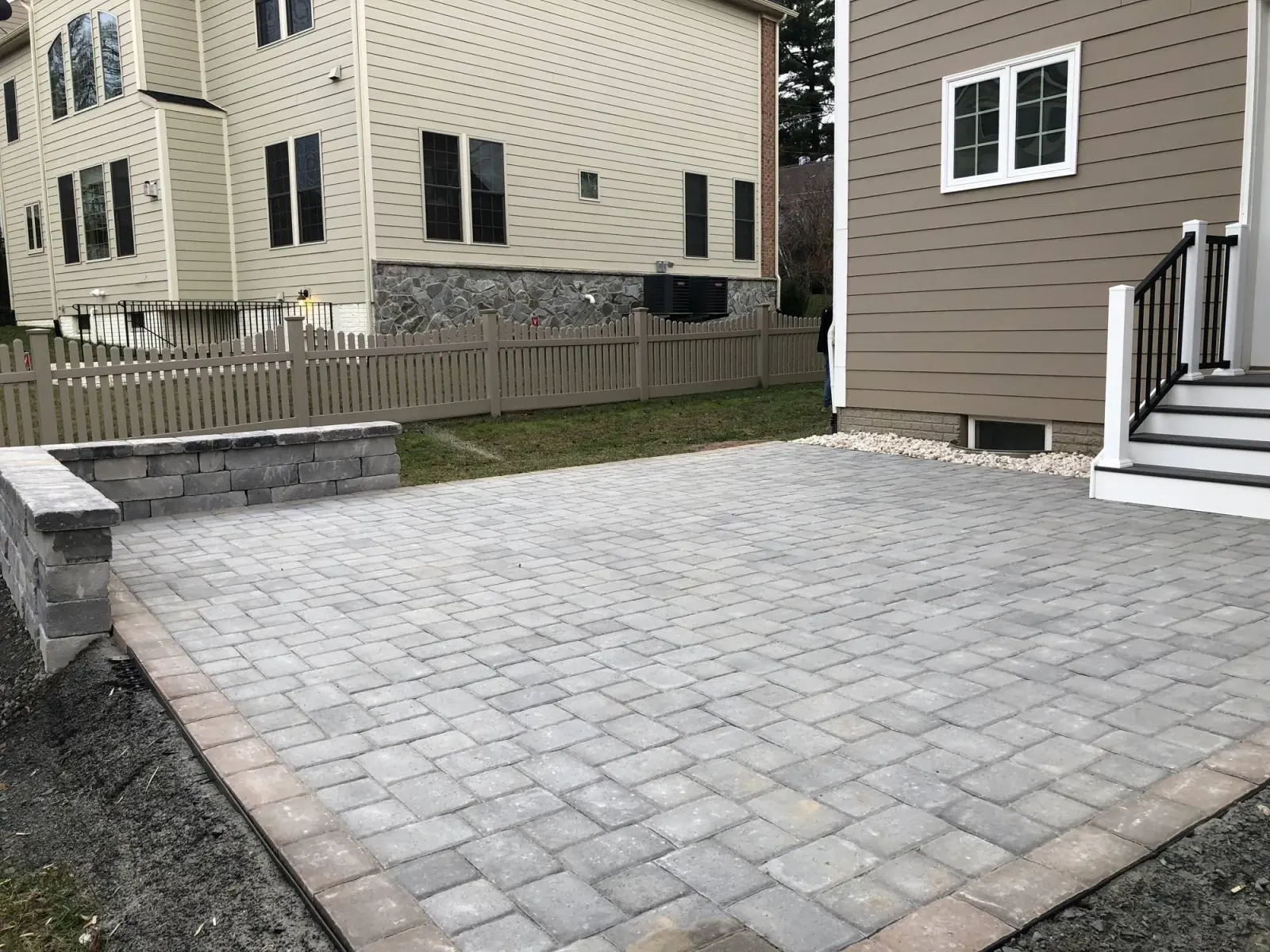
Every week someone calls and asks what a paver patio costs. It is a fair question with no simple answer, because every yard is different. Two patios of the same size, three streets apart, can price far apart because of what is under the grass and how the yard sits. So instead of quoting numbers that would be wrong for your property, this post explains what actually moves a quote up or down. After 35 years of building patios in Northern Virginia, these are the factors we price every single time.
The short answer
A patio quote comes down to six things: size, surface material, site conditions, what has to be removed first, design complexity, and how thoroughly the contractor builds the base. The first five are visible in your yard and on your wish list. The last one hides underground, and it is where quotes quietly diverge.
Size, and why doubling the area does not double the cost
Bigger patios cost more. No surprise there. But the relationship is not a straight line.
Every patio carries fixed setup work that does not change with size. We mobilize the crew and equipment, protect the lawn, stage materials, and haul away spoils. Once the machine is in your yard, adding more square footage is the cheapest part of the whole job.
The practical upshot: a patio twice the size does not carry twice the price. If you are torn between a modest patio now and the one you actually want, ask for both on the estimate. The difference is often smaller than people expect, and enlarging a patio later means paying for all of that setup a second time.
Material choice: pavers, bluestone, travertine, flagstone
The surface you walk on is the most visible line on the quote, and the spread between materials is real.
Concrete pavers are the workhorse. They are manufactured, consistent, and installed over a deep compacted aggregate base. Within the paver category itself there is a range, from standard shapes and blends up to large-format slabs and textured premium lines that take more careful cutting and layout.
Bluestone is quarried natural stone with a blue-gray color you cannot fake. Dimensional cut bluestone lays out cleanly but the stone itself carries a higher material price than most pavers, and it demands more careful handling.
Travertine is a light, cool-underfoot natural stone that people love around pools. Like bluestone, it is a step up in material cost from standard pavers.
Flagstone is a different kind of project altogether, and this matters for the quote. We do not dry-lay flagstone. We set each stone in a full mortar bed over a reinforced concrete slab, which is the right way to build a mortared stone patio that survives Virginia winters. That means the project includes forming and pouring a slab before the first stone goes down, plus the masonry labor of fitting and jointing irregular stone. It is a beautiful, permanent surface, and it is priced like the masonry work it is.
If you are weighing these options, our paver patio installation page walks through the materials we install and shows finished examples from local backyards.
Site conditions: slope, clay soil, access for machines
This is the part of the quote you cannot see from the street, and it is where I spend most of my time during an estimate visit.
Slope. A patio has to be flat, with just enough pitch to shed water. If your yard falls away from the house, we have to cut into the hill, retain the cut, or build up the low side. That usually means a retaining wall or a stepped transition, and walls are structural elements with their own excavation, footing base, and drainage backfill. A gently sloped yard might only need a thicker base on one side. A steep one changes the whole scope.
Clay soil. Most of Northern Virginia sits on heavy clay. Clay holds water, and water plus freezing temperatures is what heaves and ruins patios. On clay we excavate deeper, lay geotextile fabric to keep the base stone from pumping down into the clay, and make sure the base itself can drain. That is more digging, more stone, and more hauling, but it is the difference between a patio that is still flat in fifteen years and one that is not.
Access. Can we get a machine to the work area? A wide, open side yard lets us excavate and move stone efficiently. A townhouse backyard reached through a gate, or a yard hemmed in by trees, AC units, and fences, means smaller equipment or wheelbarrows. Every ton of soil out and every ton of stone in moves slower, and labor is a big share of any patio price.
Removing an old patio or concrete slab
If there is an existing patio, walkway, or concrete slab where the new patio goes, demolition is its own line on the quote. An old slab has to be broken up, loaded, and hauled to a facility that accepts it. Old pavers or stone come up faster but still have to be hauled. Sometimes we uncover surprises under a slab, like buried construction debris from when the house was built, and that spoil has to go too.
Demolition scope is one of the most common gaps between competing quotes. One bid includes breakout and haul-away, another quietly assumes the homeowner handles it. Make sure removal and disposal are written down.
Design complexity: curves, borders, inlays, steps, sitting walls
A simple rectangle in a running bond pattern is the most efficient patio we build. Every design element beyond that adds cutting time, layout time, or structural work.
Curved edges mean every border paver along the curve gets marked and cut individually. A contrasting soldier-course border adds a second material and a precise band of cuts around the entire perimeter. Inlays and medallions are slow, careful work in the middle of the field. Steps need a solid base of their own, and a masonry sitting wall, like the one in the photo above this post, is effectively a small retaining wall with a finished cap, built on its own compacted footing.
None of this is a reason to avoid these features. Borders and sitting walls are what make a patio feel finished and rooted in the yard. Just know that they are priced as the built elements they are, not as decoration.
What a written estimate should include
After 35 years of doing this, here is what I believe belongs in writing on any patio estimate, ours included:
- Excavation depth, in inches, so you know how much is coming out.
- Base material and compacted thickness, because the base is the patio. The surface just rides on it.
- Edge restraint type, the anchored perimeter that keeps pavers from creeping apart over the years.
- The exact surface material, pattern, and any borders or inlays.
- Demolition and haul-away, if anything is being removed.
- Cleanup, including final grading and repair of lawn areas disturbed by access.
If a quote is a single line with a number, you do not actually know what you are buying.
How to compare quotes fairly
Get every bidder to commit to the same scope in writing, then compare. Same footprint, same material, same base depth, same demolition, same cleanup. When quotes are far apart on identical scope, ask the low bidder to walk you through their base construction. Usually the gap is underground: a thinner base, no fabric over clay, or flimsy edging. Every patio looks good the day the crew leaves. The base determines what it looks like five winters later.
Ask how long the company has been building in this soil, and ask to see local work. We have been building patios from our shop in Herndon since 1991, and most of what we know about clay, slope, and freeze-thaw came from standing in Northern Virginia backyards.
If you want real numbers for your own yard, the only honest way to get them is a site visit. Request a free written estimate or call us at (571) 620-6218. We will measure, look at your slope and access, bring samples, and put the full scope in writing so you can compare it line by line.